
In the film industry, directors play a central role as creative leaders responsible for the overall artistic vision of a movie. They not only direct the production process, but also ensure that every element in the movie works harmoniously to deliver a strong and compelling story. For Digital Content Broadcasting undergraduate students , understanding the roles and responsibilities of directors is an important step in preparing themselves to enter the competitive world of digital content production.
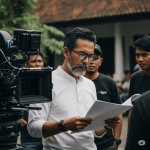
What is a Movie Director?
Directors are individuals who are responsible for both the creative and technical aspects of film production. They interpret the script, direct the actors, and work closely with the production team to realize a consistent artistic vision. As the leader of the project, directors must have strong communication skills, creativity, and a deep understanding of the various aspects of film production.
Director’s Tasks in the Pre-Production Stage
The pre-production stage is the preparation phase before the filming process begins. The director has an important role in this stage, including:
-
Concept Development and Artistic Vision: The director works closely with the screenwriter to develop the story and determine the visual style to be used.
-
Cast and Crew Selection: Determining actors who fit the characters in the script and recruiting a competent production team.
-
Technical Planning: Together with the production team, the director plans technical aspects such as shooting locations, lighting, and set design.
-
Storyboarding: Creating scene visualizations to guide the filming process and ensure visual consistency.
In the S1 Digital Content Broadcasting program, students are taught to understand and apply the pre-production process in a professional manner, preparing them to face challenges in digital content production.
Duties of the Director in the Production Stage
The production stage is the phase where the shooting process is carried out according to the plan that has been drawn up. The director’s duties in this stage include:
-
Organizing and Directing Actors: Provide direction to actors to ensure performances are appropriate to the character and storyline.
-
Coordination with Production Team: Work closely with cinematographers, sound stylists, and other departments to ensure every technical element goes according to plan.
-
Quick Decision Making: Overcome challenges that arise during filming by making effective and efficient decisions.
-
Maintain Creative Vision: Ensuring that every scene shot is in accordance with the established artistic vision.
S1 Digital Content Broadcasting students gain hands-on experience in the production process, understand the dynamics of work in the field, and learn how to manage production teams effectively.
Duties of the Director in the Post-Production Stage
After the shooting process is complete, the post-production stage is carried out to edit and perfect the footage. The director’s duties in this stage include:
-
Video Editing: Work closely with the editor to compose scenes, add visual effects, and adjust the storyline.
-
Music and Sound Preparation: Adding background music, sound effects, and mixing audio to create the desired atmosphere.
-
Color Grading: Adjusting colors to create a consistent visual aesthetic and support the narrative.
-
Evaluation and Revision: Reviewing the final output and making revisions where necessary to ensure the quality of the movie is up to the desired standard.
In the S1 Digital Content Broadcasting program, students learn post-production techniques using professional software, enhancing their technical skills in producing quality digital content.
Conclusion
The director’s role in filmmaking is vital, covering the entire process from pre-production to post-production. They are responsible for the creative vision, team coordination, and final quality of a movie. For S1 Digital Content Broadcasting students, understanding and mastering the role of a director is an important step in building a career in the dynamic and competitive digital content industry.
Join us at S1 Digital Content Broadcasting and improve your digital literacy skills for a brighter future in the media industry! Apply now and be part of a generation of innovative digital content creators.
General Requirements
- Graduates of SMA / SMK / MA / Equivalent
- Have copies of diplomas, academic transcripts, and certificates of participation in national and international championships*
- Have an Equalization Letter from the Ministry of Education, Culture, Research, and Technology of the Republic of Indonesia for applicants with overseas graduates or homeschooling. Click here for more information
Registration Steps
- Find Information about Telkom University New Student Admission
- Create an Account
- Complete Personal Data
- Complete Registration Data
- Print Participant Card
Selection Path
Active Selection Path for all D3 and S1 programs can be seen on the following page.
https://smb.telkomuniversity.ac.id/jalur-seleksi/#diploma-sarjana
Telkom University has several components of tuition fees for each study program, namely:
- UP3 (Uang Partisip Penyelenggaraan Pendidikan) is development money. UP3 is only paid once at the beginning of registration.
- SDP2 (Regular Education Development Fund Contribution) is a donation money. SDP2 is only paid once at the beginning of registration.
The SDP2 fee is differentiated based on the selection path followed, namely:
-
- Regular Pathway, all selection pathways opened other than the USM pathway
- USM Path, a special pathway for Partner Selection Invitation (USM)
- BPP (Tuition Fee) is the tuition fee paid every semester during the lecture.
Telkom University has several components of tuition fees for each study program, namely:
- UP3 (Uang Partisip Penyelenggaraan Pendidikan) is development money. UP3 is only paid once at the beginning of registration.
- SDP2 (Regular Education Development Fund Contribution) is a donation money. SDP2 is only paid once at the beginning of registration.
The SDP2 fee is differentiated based on the selection path followed, namely:
-
- Regular Pathway, all selection pathways opened other than the USM pathway
- USM Path, a special pathway for Partner Selection Invitation (USM)
- BPP (Tuition Fee) is the tuition fee paid every semester during the lecture.
| Name of Study Program | UP3 | SDP2 (General Pathway) | SDP2 (USM Pathway) | BPP/Semester |
| S1 Digital Content Broadcasting | Rp9,000,000 | Rp12,000,000 | Rp20,000,000 | Rp10,000,000 |
Author: Ariq Raii Aryandra
Direktorat Pusat Teknologi Informasi
Tags: Director